
Pearl HotelsScaling Hospitality: A Lighthouse Design to Recoup $9M in Annual Labor Waste
System Consolidation
Action: Merged 17 tools to eliminate "Toggle Tax."
Result: Eliminated the "Toggle Tax" and reduced cognitive load for agents.
Workflow Optimization
Action: Re-engineered the booking flow to handle 95% of common global inquiries.
Result: Projected to shave at least 30 seconds off the Average Handle Time.
Scalable Architecture
Action: Established a standardized design system for global service centers.
Result: Accelerated agent trainign by 50% and slashed future development costs.
$9M Saved
Projected annual labor waste recovery.
Pearl Hotels’ Service Center Agents navigate a large ecosystem of programs when interacting with guests, slowing down productivity. We researched and designed a Lighthouse desktop tool for Agents, reducing employee training time and burnout, improving upsell opportunities and guest loyalty, and reclaiming $9M annually in productivity.
Role
Product Designer
Year
2022
Duration
12 months
Team Members
Lead Design Strategist
Project Manager
UX Researcher
Solution Architect
Deliverables
Stakeholder interviews
Service blueprint
Competitive analysis
Low & high fidelity designs
Design library
Prototypes
Executive presentations
Final specs
Asset production
Problem StatementA packed toolbox costs Pearl Hotels millions in training time, employee burnout, and lost guest loyalty.
“We log into like five things at once. Computer, then Citrix, then the phone, Reserve, then Teams... All these things are needed, but you’re typing in your password five times.”
Fragmented workflows forced agents to navigate 17 disconnected systems, creating a ‘toggle tax’ that slowed ever guest interaction. This complexity didn’t just frustrate agents; it inflated onboarding costs and risked guest loyalty through inconsistent service. Hyatt required a unified ‘Lighthouse’ vision to prove that consolidation could reclaim $8M in lost productivity.
User research, personas, & user journeyGuest service agents are slowed down by navigating 17 clunky, unintuitive tools.
“I do have multiple screens up... one, the original booking I want to compare, and then the second reservation screen where I can look up other options, and another screen with a list of codes we use to look up properties and discounts. Even then, adding another guest feels like making a second booking.”
By shadowing agents globally, we identified that 40% of interaction time was spent navigating between windows rather than helping guests. Mapping the journey across 17 tools revealed critical ‘friction points’ where data was manually re-entered, increasing the risk of costly booking errors.
One (of many!) user journey maps we made, illustrating the complex processes and tools an agent would go through and use for different questions from a guest.
Activities
Call handling recordings reviews
User interviews
Ride-alongs
Trainee interviews
Outputs
Affinity maps
User journeys
Service blueprint
Pain point documentation
Research repository
Sketches, wireframes, & prototypeTargeting the 95%: Prioritizing High-Volume Workflows
We focused our design sprints on the booking engine, which accounted for 95% of all service center inquiries. By co-creating with global business leaders and agents, we ensured the new interface solved the most expensive problems first, providing the fastest path to ROI.
“There are all these steps after booking a connecting room to guarantee it. What would happen if the guest doesn’t want to wait, or if the hotel doesn’t answer the call? ”
“Does the room have a tub? Does it have a shower? Some hotels’ information is in here, some don’t. We pretend to be the hotel, but then we can’t confirm information. It puts us in an awkward position.”
Activities
Ideation workshops
Money voting workshops
Ideation workshops
Steering committees
Outputs
Feature repository
Feature prioritization
Conceptual designs
Stress-Testing the Vision Against Global Complexity
TestingWe ‘pressure-tested’ the prototypes against the most convoluted guest scenarios, from split-payment wedding blocks to multi-currency loyalty redemptions. Testing revealed critical friction points for European agents handling VAT and multi-currency split payments, and Asian agents having to translate in real time. We iterated the design to ensure the ‘Lighthouse’ was truly global, not just regional. This global iterative cycle allowed stakeholders to validate the solution’s feasibility before committing to a multi-year engineering roadmap.
“Sometimes the guest speaks English, sometimes they don’t. We get used to reading in English and then translating to Mandarin. I need some time to translate and offer the options, but I get used to it.”
An iteration showing the current guest's details, consolidated tools, and hotel search results, two of which the user has chosen to compare to each other.
Activities
Usability sessions
Affinity mapping
Outputs
High-fidelity designs
Design library
Prototypes
Final PrototypeLanding on a Complexity-Proof Lighthouse Design
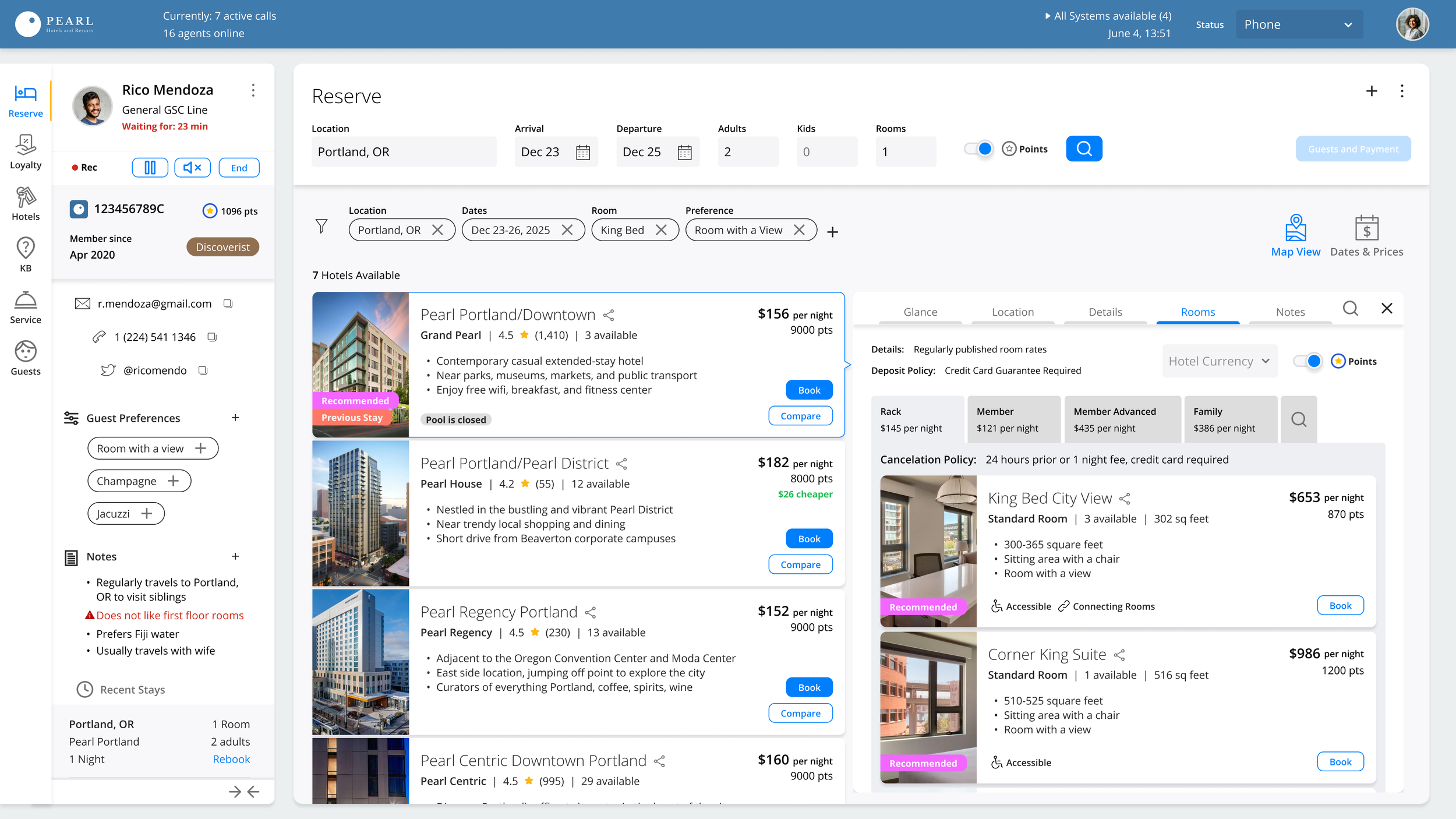
The final design showing the selected reservation tool, an expandable/collapsible guest details panel, and fully dedicated reservation panel populated with hotel and room search results.
Activities
Stakeholder presentations
Developer meetings
Outputs
Presentation deck
Design library
Prototypes
Annotated redlines
The final ‘Complexity-Proof’ design reduced the average interaction time from 6.5 minutes to 4.5 minutes, depending on the client inquiry. Beyond the $8M in projected labor savings, the unified tool creates an ‘Acquisition Engine,’ allowing Hyatt to onboard new hotel properties into the ecosystem in half the time previously required.
“Comparing the hotel rooms... it’s just easy. Its really better, it’s a lot better!”
Strategic RoadmapBeyond the Prototype: A Blueprint for Global Scalability
This lighthouse design served as more than a UI refresh; it acted as a strategic North Star for Hyatt’s digital transformation. By proving that $9M in labor waste was possible through consolidation, we secured executive buy-in for a multi-year phased rollout. The project shifted the conversation from “fixing a tool” to “building a scalable platform” that can absorb new hotel acquisitions with zero added complexity, and empower agents with opportunities to upgrade and upsell guests.
“Comparing rates like this is way easier, and I can focus on how I sell more expensive properties.”
In addition to introducing the "Map View" of property search results, we also proposed a "Dates & Prices" view that provided agents with upsell opportunities by comparing dates and prices.