Pearl HotelsScaling Hospitality: How Research Unlocked $9M in Annual Labor Savings
System Consolidation
Action: Merged 17 tools to eliminate "Toggle Tax."
Result: Agents spent less time context-switching and more time helping guests — directly reducing average handle time.
Workflow Optimization
Action: Re-engineered the booking flow to handle 95% of common global inquiries.
Result: Projected to shave at least 30 seconds off the Average Handle Time.
Scalable Architecture
Action: Established a standardized design system for global service centers.
Result: Accelerated agent training by 50% and slashed future development costs.
$9M Saved
Projected annual labor waste recovery.
Pearl Hotels' Service Center Agents were drowning in 17 disconnected systems, costing millions in training time, agent burnout, and lost guest loyalty. As the UX Researcher on this engagement, I led the research workstream that diagnosed the problem, defined the opportunity, and gave the design team the evidence they needed to build Lighthouse — a unified desktop tool that recovered $9M in annual productivity.
Role
UX Researcher
Year
2022
Duration
12 months
Team Members
Lead Design Strategist
Project Manager
UX Researcher
Solution Architect
My Contribution
Research planning
Ride-alongs
User interviews
Data/Feedback synthesis
Journey mapping
Usability testing
Deliverables
Stakeholder interviews
Affinity mapping
User journey maps
Service blueprint
Pain point documentation
Research repository
Research to design translations
Executive presentations
Note: My role on this engagement was UX Researcher. The visuals, wireframes, and prototypes shown here are my own recreation and reinterpretation of the original work for portfolio purposes, and do not represent final deliverables I personally designed.
Problem StatementA packed toolbox costs Pearl Hotels millions in training time, agent burnout, and lost guest loyalty.
“We log into like five things at once. Computer, then Citrix, then the phone, Reserve, then Teams... All these things are needed, but you’re typing in your password five times.”
Agents were navigating 17 disconnected systems just to answer a single guest question — a "toggle tax" that slowed every interaction and compounded across thousands of daily calls. This fragmentation didn't just frustrate agents; it inflated onboarding costs, introduced booking errors, and put guest loyalty at risk through inconsistent service. Pearl Hotels needed a unified vision and a research-backed business case — to prove that consolidation could reclaim $9M in lost productivity.
User research, personas, & user journey40% of every agent interaction was spent navigating tools — not helping guests.
“I do have multiple screens up... one, the original booking I want to compare, and then the second reservation screen where I can look up other options, and another screen with a list of codes we use to look up properties and discounts. Even then, adding another guest feels like making a second booking.”
Through ride-alongs and interviews across global service centers, I mapped how agents actually worked, finding that agents spent significant time switching between windows, manually re-entering data, and compensating for gaps between systems. Synthesizing these sessions into journey maps and a service blueprint gave the team a shared, evidence-based picture of where time and money were being lost.
One (of many!) user journey maps we made, illustrating the complex processes and tools an agent would go through and use for different questions from a guest.
Sketches, wireframes, & prototypeTargeting the 95%: Research-Backed Prioritization of High-Volume Workflows
Based on my research, we targeted the highest-level opportunity for consolidation: the booking experience. I facilitated co-creation sessions with global agents and business leaders to surface which pain points were most costly, and synthesized those findings to give the design team a clear, prioritized brief. This research-led prioritization meant the team was solving the most expensive problems first, not just the most visible ones.
“There are all these steps after booking a connecting room to guarantee it. What would happen if the guest doesn’t want to wait, or if the hotel doesn’t answer the call? ”
“Does the room have a tub? Does it have a shower? Some hotels’ information is in here, some don’t. We pretend to be the hotel, but then we can’t confirm information. It puts us in an awkward position.”
Pressure-Testing for Global Complexity, Not Just Edge Cases
TestingOnce prototypes were in hand, I led usability sessions with agents across regions, deliberately targeting the most complex scenarios: split-payment wedding blocks, multi-currency loyalty redemptions, and real-time language translation. Testing surfaced two critical gaps — European agents needed VAT and multi-currency support baked into the workflow, and Asian agents needed interface accommodations for real-time translation. These weren't edge cases; they were regional requirements that would have broken the tool at scale. Each round of findings fed directly back into improving the design on a global scale.
“Sometimes the guest speaks English, sometimes they don’t. We get used to reading in English and then translating to Mandarin. I need some time to translate and offer the options, but I get used to it.”
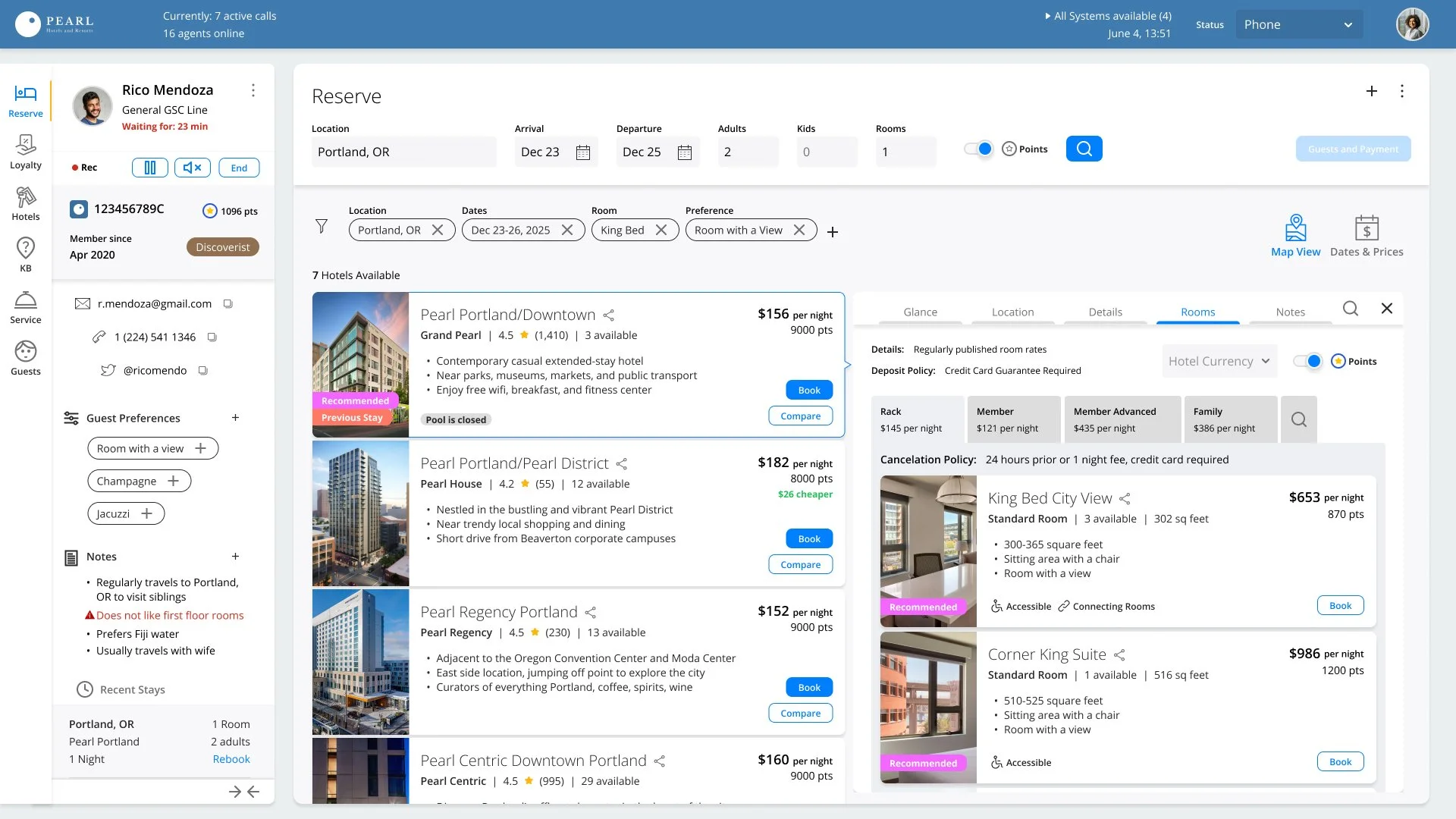
An iteration showing the current guest's details, consolidated tools, and hotel search results, two of which the user has chosen to compare to each other.
Final PrototypeA Complexity-Proof Design, Validated by the People Who'd Use It
The final design showing the selected reservation tool, an expandable/collapsible guest details panel, and fully dedicated reservation panel populated with hotel and room search results.
The final Lighthouse design was projected to reduce average interaction time from 6.5 to 4.5 minutes — a direct result of consolidating 17 tools into one workflow built around how agents actually work. Beyond the $9M in projected labor savings, the unified platform creates a scalable acquisition engine: new hotel properties can be onboarded in half the time previously required, turning a cost center into a growth lever.
“Comparing the hotel rooms... it’s just easy. Its really better, it’s a lot better!”
Strategic RoadmapFrom Fixing a Tool to Building a Platform
Lighthouse wasn't just a UI refresh — it was a strategic proof of concept. The research I produced gave executives a quantified, evidence-backed case for consolidation, shifting the conversation from "can we fix this?" to "how do we scale this?" By demonstrating that $9M in labor waste was recoverable, the project secured buy-in for a multi-year phased rollout and positioned Pearl Hotels' service centers as a scalable platform — capable of absorbing new acquisitions without adding complexity or retraining burden.
“Comparing rates like this is way easier, and I can focus on how I sell more expensive properties.”
In addition to introducing the "Map View" of property search results, we also proposed a "Dates & Prices" view that provided agents with upsell opportunities by comparing dates and prices.