
Martin Tiger FinanceOperational Agility: Annually eliminating 5,000 manual processing days
Discovery & Diagnosis
Service Mapping: Audited the end-to-end removal journey to identify dead time and information gatekeeping between Branch and Home Office.
Result: Exposed a 5-day operational bottleneck creating high client anxiety and compliance risk.
Logic Integration
Front-End Empowerment: Research findings directly informed the decision to surface backend calculation logic into the Branch UI via the design system.
Result: Transformed a blind dependency into real-time transparency and immediate error resolution.
Workflow Optimization
Friction Removal: User interviews surfaced the true cost of status-tracking, redundant verification, and multi-system hand-offs.
Result: 100% reduction in back-and-forth communication, freeing branches for high-value client advisory.
Systemic De-Risking
Standardized the calculation process to ensure 100% compliance with tax-sensitive removal deadlines.
5,000 manual processing days saved annually and total elimination of 'human-error' restitution costs.
Financial clients at Martin Tiger must remove excess retirement contributions to avoid tax penalties — but branches were completely blind to the required calculations, creating a 5-day dependency on Home Office. Through service mapping and user research, I diagnosed the bottleneck and identified the fix: surfacing the calculation engine directly into the branch UI. The result was a transformation from a 5-day delay to a 5-minute resolution.
Role
UX Researcher
Year
2024
Duration
6 months
Team Members
Product owner
Product designer
Business analyst
My Contributions
Problem identification
Project pitch
Service mapping
Research planning
Stakeholder/user interviews
Usability testing
Research to design recommendations
Deliverables
Service blueprint
Low & high fidelity designs
Prototypes
Executive presentations
Final specs
Asset production
Note: My role on this engagement was UX Researcher. The visuals, wireframes, and prototypes shown here are my own recreation and reinterpretation of the original work for portfolio purposes, and do not represent final deliverables I personally designed.
Problem StatementBranch Agents Were Flying Blind — With Real Tax Consequences
“We are NOT fans of waiting for Home Office to review. We have to check regularly for the response with the calculation, then call back the client, then confirm with Home Office how the client wants to continue.”
Clients at Martin Tiger must remove excess retirement contributions to avoid tax penalties, but branches were "blind" to the required calculations, creating a 5-day dependency on the Home Office. This delay increased the risk of compliance errors, elevated client anxiety during tax-sensitive windows, and orced branch agents to act as manual go-betweens.
The Discovery: Service MappingEradicating "Dead Time" in the Service Lifecycle.
“Our current process requires branches to submit through different systems depending on the dollar amount, asset movement type, account type, and program type. These requests have to go through Home Office review, leading to delays, inconsistent branch and client experience, and lack of client visibility into the final dollar amount.”
Through service mapping, I identified 3–5 days of dead time spent waiting for manual back-office confirmations. This zig-zag workflow didn't just slow down the transfer — it created a high-risk window for tax liabilities and compounding human error. The service blueprint made the bottleneck undeniable: calculation logic was being gatekept in the back office when it needed to live at the point of client contact.
The service blueprint for Excess Removals, illustrating the delays caused by back-and-forth conversations between branches and Home Office.
The Design StrategyFrom Research Insight to Design Direction: Making the Invisible Visible
The service blueprint didn't just document the problem — it became the artifact that aligned stakeholders on the solution. By making the 5-day dead zone visible, research created the shared mandate needed to justify a significant change: moving the calculation engine from a back-office gatekeeping function to a real-time front-line tool. The updated blueprint — with the Home Office dependency removed — served as the north star for the product and design team throughout build.
The proposed service blueprint for Excess Removals, allowing branches direct access to the calculator and reducing 3-5 days from this process.
Validation Research Confirmed: Instant Calculation Changes the Entire Service Dynamic
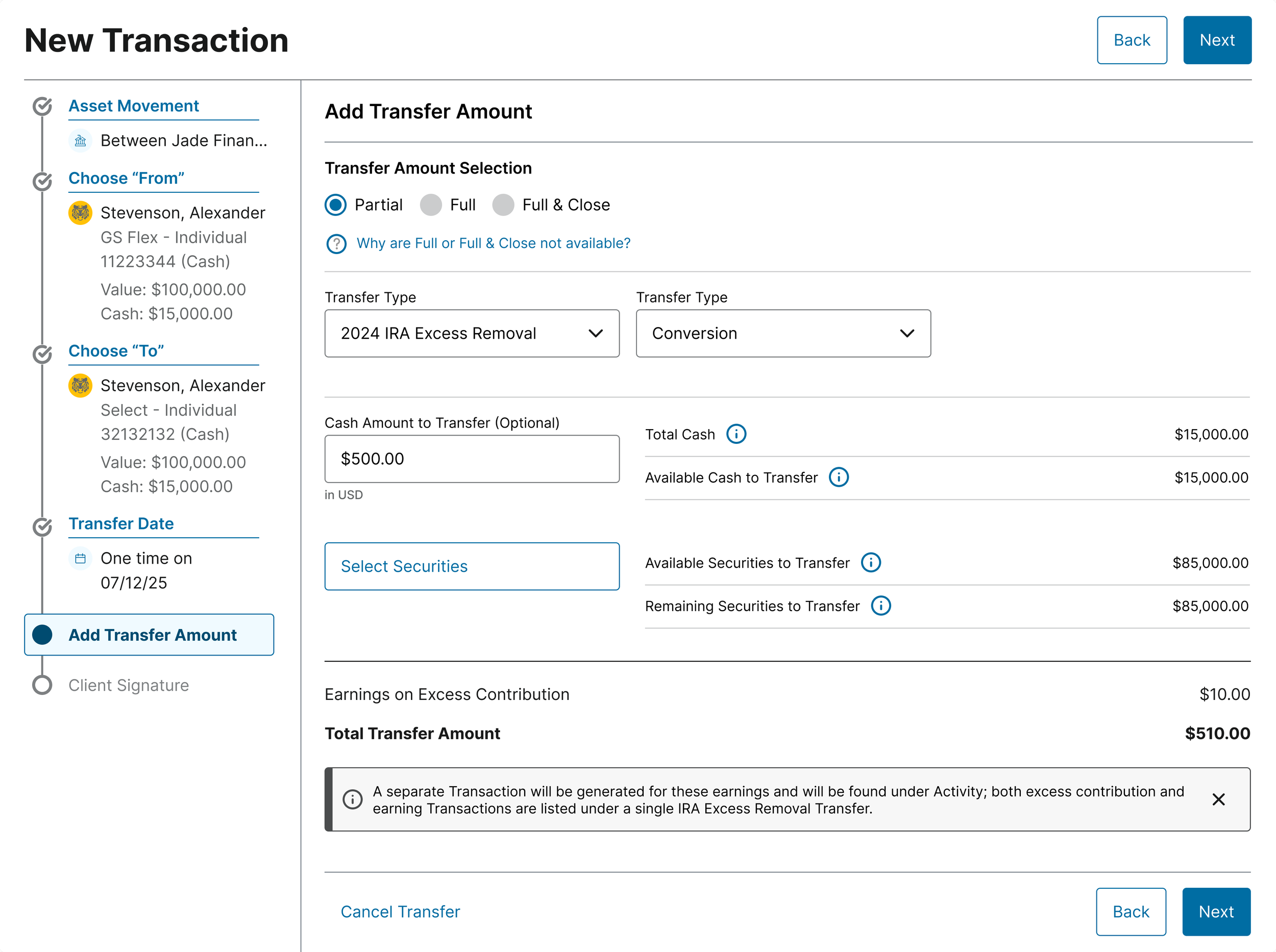
Validation & TestingUsability testing confirmed that instant calculation removed the core source of branch friction — the need to manually track 1,000+ annual transfers across disconnected systems. Users across both financial advisor and branch administrator roles reported that the new flow let them stay focused on client advisory rather than acting as status checkers for manual paperwork.
“... it’s more streamlined and informational - you get more information immediately than filling out a form. We don’t see the earnings or loss on the excess removal now, so having it all right here and immediately calculated I do think is better.”
Martin Tiger’s banking center’s UI, updated with the instant calculation and the ability to select how the amount will be removed from the retirement account.